
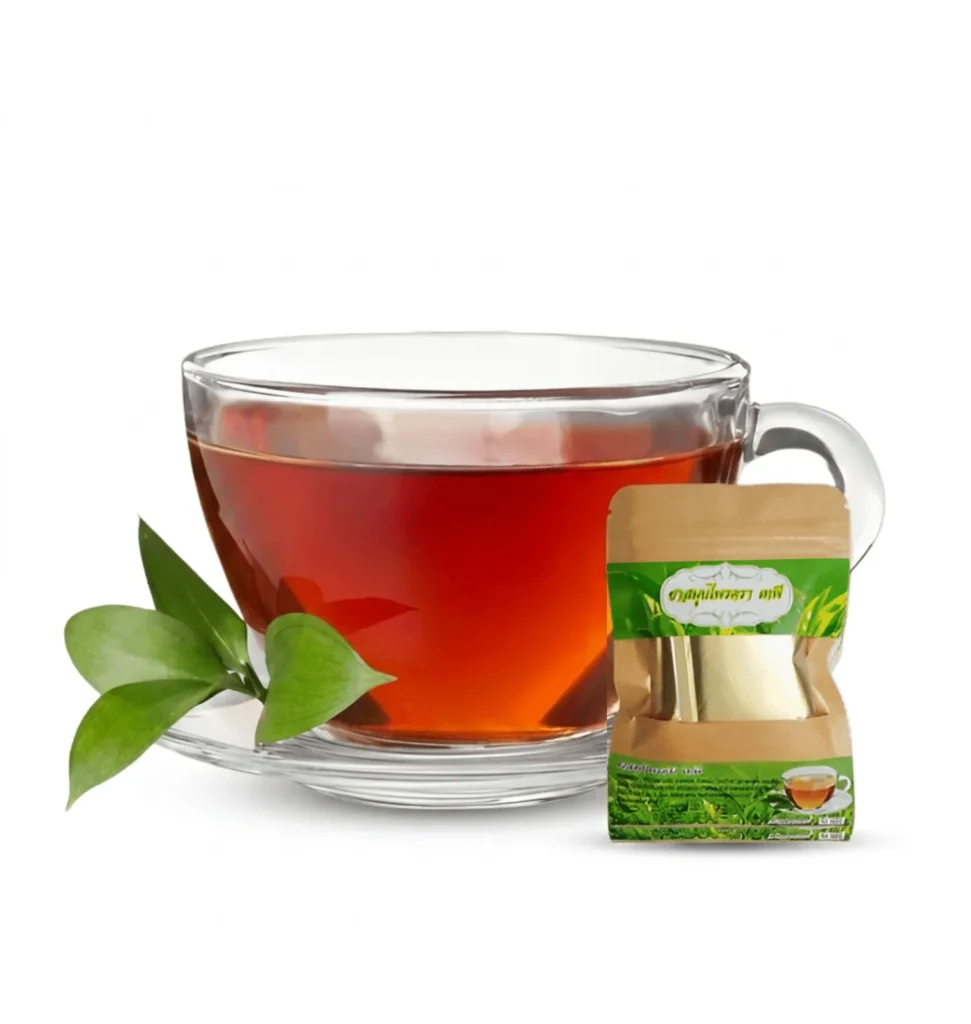
Tapee Tea brews a deep red-amber cup with a woody, earthy base, a fresh herbaceous lift and a warm spice finish. It is caffeine-free, made from 15 finely ground Thai botanicals rather than tea leaf, and it leans earthy and pleasantly bitter.
The first impression: colour, aroma and body
Pour the water and the colour arrives fast. Because the botanicals are finely ground rather than coarsely cut, one teabag gives a fuller infusion than cut herbs would, and the cup deepens to red-amber as it steeps. Held to the light it reads red; against a white cup, amber-brown.
Every teabag is sealed in its own gold-foil sachet, so the first thing you meet is the dry aroma as you tear one open — woody and rooty, with the spice sitting just behind it. In the cup that order flips: the spice comes forward as the water does its work, and the woodiness settles underneath.
The three layers of the flavour
Fifteen botanicals is a lot to pick apart in a single cup, so it is easier to taste Tapee Tea in layers. There are three: an earthy, woody base; a warm spice layer sitting over it; and a fresh herbaceous lift that keeps the cup from feeling heavy.
1. The earthy, woody base
This is the layer you meet first and the one that stays longest. Jewel Vine (Derris scandens) is the woody backbone of the blend, with vetiver laying earthy base notes underneath it. Thai Black Ginger (Kaempferia parviflora) adds a dark, rooty depth, sandalwood a soft fragrant one, and lovage a savoury edge that stops the base ever tasting sugary. Bark, dried root, forest floor — that register.
2. The warm spice layer
Over the base sits the spice, and it is the layer that reads most familiar straight away. Cinnamon brings sweet, warm bark; nutmeg the baking-spice finish; cardamom a warm sweet-aromatic note; and Sand Ginger (Kaempferia galanga) an aromatic rhizome character. Star anise (Illicium verum) is the one that lingers — distinctive, and usually the last thing left on the palate.
3. The fresh herbaceous lift
The third layer is quieter, but it is what makes the cup lively rather than dense. Cat’s Whiskers (Orthosiphon aristatus) gives a leafy herbaceous lift, sea holly a regional herbaceous note, and orange blossom a floral top that shows most in the steam. Goji berry rounds and balances the edges, and Saul Waeng — a regional Thai botanical carried over from the traditional recipe — sits in among them. If you want the whole picture, our page on the 15 botanicals in Tapee Tea and what each one contributes takes them one at a time.
| Layer | Mainly from | What you taste |
|---|---|---|
| Earthy, woody base | Jewel Vine, vetiver, Thai Black Ginger, sandalwood, lovage | Bark, dried root, savoury depth |
| Warm spice | Cinnamon, nutmeg, cardamom, star anise, Sand Ginger | Sweet-aromatic, baking spice, lingering anise |
| Herbaceous lift | Cat’s Whiskers, sea holly, orange blossom, goji berry, Saul Waeng | Leafy, floral, gently rounded |
Is Tapee Tea bitter?
We will not dress this up. Tapee Tea leans earthy, and there is a pleasant bitterness running right through it. It is the rooty, unsweetened sort of bitterness that sits at the back of the cup rather than the sharp kind that grips the front of the tongue, and it fades out into the star anise and nutmeg instead of hanging around. If you already drink strong, unsweetened rooty infusions, it will read as completely ordinary. If your usual cup is a sweet fruit infusion, the first mug will be a change of gear.
It drinks well exactly as it comes, or you can soften it with a little honey, a slice of lemon or a spoon of sugar, all of which pull the spice layer forward and push the earthiness back. There is no wrong way round it — it is a question of flavour, not of doing it properly — though it is worth trying one cup plain before you decide.
How does brewing change the taste of Tapee Tea?
More than most infusions, this one moves with the steep. The starting point is one teabag in 250–300 ml of water just off the boil for three to five minutes, with a gentle stir for a fuller extraction. From there:
- Three minutes — lighter in colour and lighter in the mouth. The spice and floral notes are proportionally louder, the woody base is thinner, and the bitterness is barely there.
- Five minutes — a deeper red-amber, a much fuller woody base, and a bitterness that is clearly part of the cup rather than a hint of one.
- Less water — 250 ml rather than 300 ml concentrates everything, bitterness included. More water does the reverse without changing the shape of the flavour.
If you are working out your own cup, start at three minutes and creep upwards until it tastes right to you. Our guide to brewing Tapee Tea hot and iced goes through the method step by step.
What does iced Tapee Tea taste like?
Iced, it is close to a different drink. Brew it at double strength and pour it straight over ice: the cup reads crisper, the spice comes further forward, and the red-amber colour looks brighter in a glass than it ever does in a mug. A slice of lemon works well here. This is the version we would put in front of someone who found the hot cup too heavy.
Who tends to enjoy the flavour
This is a matter of taste and nothing more. If you like earthy, rooty, barky infusions — the kind you drink unsweetened and slowly — Tapee Tea is likely to suit you, as it is if you enjoy a strong anise or cinnamon note in a drink. If you prefer light, sweet, fruity cups, it is honestly not the obvious pick, and we would rather you knew that before ordering than after.
How is Tapee Tea different from regular tea?
Worth saying plainly: this is not tea in the botanical sense. There is no Camellia sinensis leaf in the blend and no caffeine, so you will not find the tannic, drying grip of an over-steeped black tea. Leaving the bag in longer does not punish you the same way either — it simply makes the cup deeper, darker and more bitter, which is why the steep time is the main dial you have. For the background to the blend, its format and where it is made, read our explainer on what Tapee Tea is.
If earthy, spiced and honestly bitter sounds like your kind of cup, our Thai 15-botanical tea in gold-foil sachets comes in pack sizes from 50 teabags upwards, current prices are always on the product page, and shipping and returns are set out on our ordering page.