
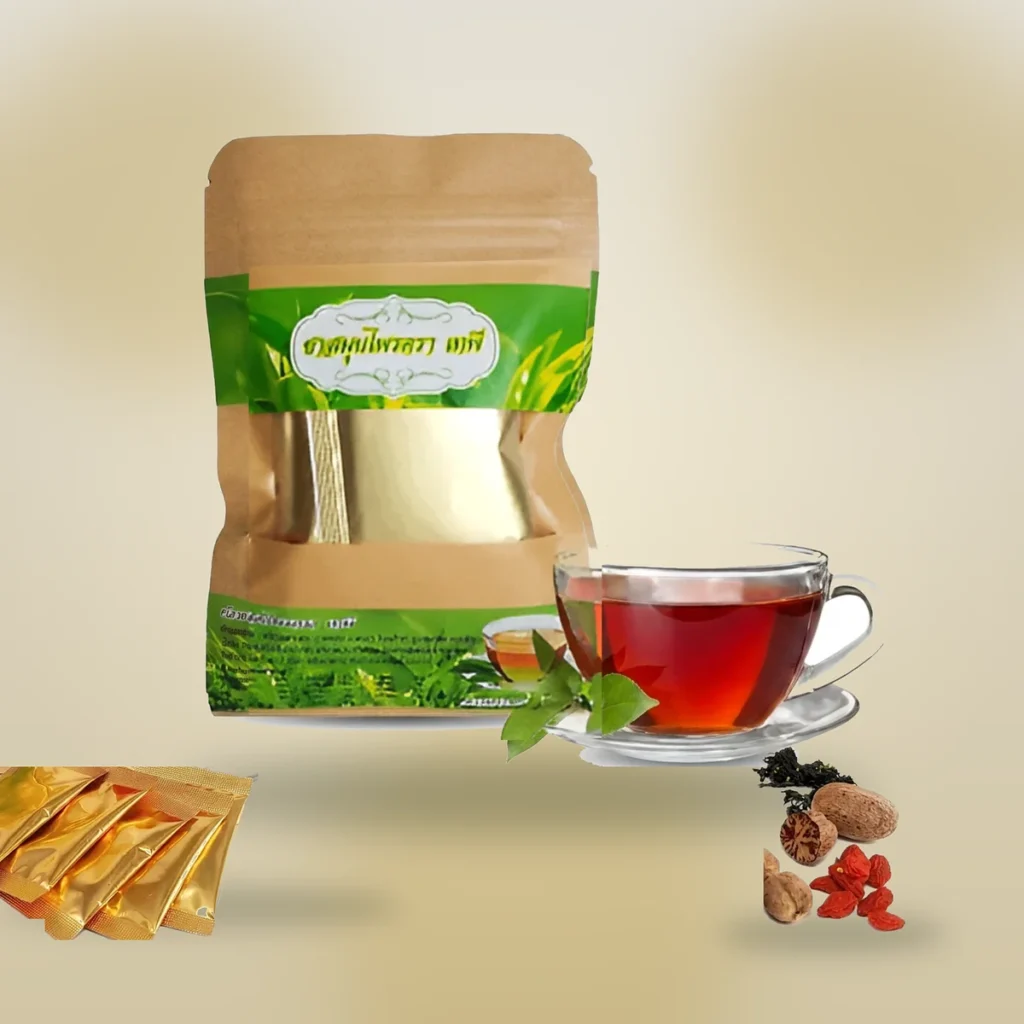
Tapee Tea is a traditional Thai herbal blend of 15 botanicals, brewed as a caffeine-free tisane. It contains no tea leaf at all. The finely ground botanicals are filled into single-cup teabags, each sealed in its own gold-foil sachet, and the cup they make is deep red-amber, woody and earthy with a warm spice finish.
Tapee Tea in plain terms
Tapee Tea is a drink. Fifteen botanicals — from woody Jewel Vine to Orange Blossom and Goji Berry — are ground fine, blended to one recipe and portioned into teabags, so that one bag makes one cup. You steep it in hot water the way you would any teabag, and you drink it, hot or over ice.
That is the whole definition. On this site we describe what is in the packet, what it tastes like, how to brew it and how it reaches you — and we leave it at that.
- What it is: a Thai herbal blend of 15 botanicals, brewed like tea.
- What it is not: tea leaf. There is no Camellia sinensis in it, and it is caffeine-free.
- Format: finely ground botanicals in single-cup teabags, each sealed in its own gold-foil sachet.
- Cup: deep red-amber, woody and earthy, with a herbaceous lift and a warm spice finish.
- Origin: blended and packed in Thailand.
- Served: hot, or brewed double strength and poured over ice.
Is Tapee Tea a tea or a tisane?
Strictly speaking, the word “tea” means the leaf of Camellia sinensis. Tapee Tea contains none of it, which makes it a tisane: a drink infused from herbs, spices, roots, barks, seeds and flowers rather than from tea leaf. It is caffeine-free.
The name has stuck to it anyway, because the ritual is identical — hot water, a bag, a few minutes, a cup. We use the word the way people actually use it, and we stay exact about what is in the packet.
What are the fifteen botanicals in Tapee Tea?
The backbone of the blend is Jewel Vine (Derris scandens), the woody note that carries the whole infusion. Around it sit Vetiver for earthy base notes and Thai Black Ginger (Kaempferia parviflora) for dark, rooty depth, with Sand Ginger (Kaempferia galanga) adding an aromatic rhizome note and Sandalwood a soft fragrant one.
The lift comes from Cat’s Whiskers (Orthosiphon aristatus) and Sea Holly, both herbaceous, and from Orange Blossom, which is floral. Goji Berry rounds and balances the blend, Lovage brings savoury depth, and Saul Waeng, a regional Thai botanical, comes from the traditional recipe.
The finish is spice: Cardamom, warm and sweet-aromatic; Cinnamon, a sweet warming bark; Nutmeg, a baking-spice note; and Star Anise (Illicium verum), the distinctive one that lingers longest. The full list, botanical by botanical, is set out on our page about the 15 botanicals in Tapee Tea.
What is a cup of Tapee Tea like?
Poured, it is a deep red-amber.
The flavour arrives in three layers: a woody, earthy base, a fresh herbaceous lift through the middle, and a warm spice finish. It leans earthy, and it is pleasantly bitter. That is worth saying plainly, because it is not a sweet, fruity tisane and it does not pretend to be one — if earthy and pleasantly bitter is your kind of cup, this is that cup. Fuller tasting notes are on our page on what Tapee Tea tastes like.
How is Tapee Tea served?
As a beverage, plainly. One teabag per cup, 250–300 ml of water just off the boil, steeped for three to five minutes. Stir gently before you drink it and the extraction is fuller. Because the botanicals are ground rather than coarsely cut, the infusion is fuller than cut herbs would give in the same few minutes.
Iced, it works just as well: brew it at double strength, then pour it over ice.
Quantities, timings and the iced method are all in our guide to how to brew Tapee Tea.
The format: ground botanicals, one cup at a time
Two things about the format are worth knowing, because they are unusual.
First, the botanicals are ground fine — a powder rather than cut leaf — before they go into the bag. That is what gives the fuller infusion described above.
Second, every teabag is sealed in its own gold-foil sachet. Not the box, not an inner bag of twenty: each single bag, wrapped on its own. It means a bag travels well in a coat pocket, a desk drawer or a suitcase, and the pack you opened last month is still sealed bag by bag. The whole format is explained on our page about the gold-foil teabag format.
Packs run from 25 teabags up to 250 — 25, 50, 75, 100, 125, 150 and 250 — and one teabag is one cup, so the pack size is simply how many cups you are buying. Larger packs cost less per cup — the arithmetic is on our price per cup by pack size page — and current prices are always on the product page.
Is it spelled Tapee Tea, Tepee Tea or Thephi?
You will see the name romanised in several ways — Tapee, Tepee, Thephi — different transliterations of the same Thai name. We spell it Tapee Tea throughout this site.
Who makes Tapee Tea, and who sells it?
The blend is made and packed in Thailand. This shop is run by a company registered in Thailand; our company details are on our contact page, and there is more about how we work on our about page. If you would rather ask a person, we read every message sent to service@tapeetea.net.
Orders are dispatched from Thailand within one to three business days and typically arrive six to fourteen business days after dispatch, fully tracked. We ship to the United States, the United Kingdom, the EU, Canada and most other countries, and EU orders travel tracked; where EU import charges apply, they are collected on delivery for the time being. We do not ship to Australia or New Zealand. How ordering works, country by country, is on our page about how to order Tapee Tea; the full terms are in our shipping policy.
If that sounds like your kind of cup, our 15-botanical Tapee Tea teabags are here in pack sizes from 25 to 250, with current prices on the page.